


INGESTION
Inputs from the LIS and WSIs make it possible to evaluate a case prospectively.
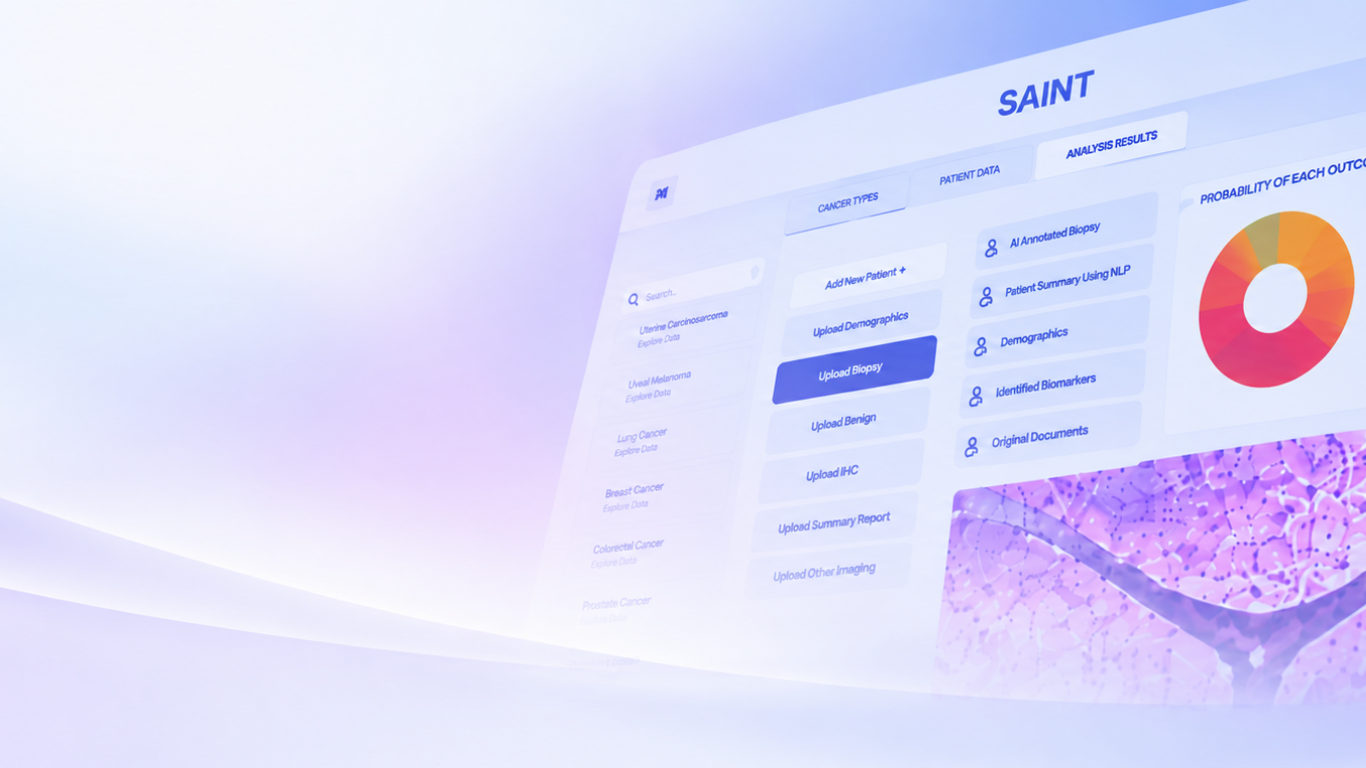
Meet SAINT
In GI pathology, most cases are normal and benign. We use AI to identify what is normal and what is not. This allows you to triage and prioritize accordingly and accelerate the review and reporting process.
Meet SAINT
Our focus is on the high throughput diagnostics for routine cases initially in colorectal specimens. We evaluate all H&E slides to inform you what appears to be normal before you ever open the first image.
Meet SAINT
SAINT’s algorithms are developed in collaboration with board-certified pathologists, using expert-reviewed datasets and protocols to support rigorous precision.
Speed and Accuracy
Designed to support more efficient review, SAINT can assist with case organization and highlighting cases for further evaluation. We help you focus your time on priority cases.
Created with expert input and validated with scientific rigor, SAINT provides clinical confidence and reduces diagnostic uncertainty.
.
Built for integration within existing Pathology PACS (IMS) and LIS environments. SAINT is designed to integrate within your existing infrastructure, so results are available within the system you use today.
The Truth Loop
SAINT combines clinical information with image morphology. Those results are shared with you. You agree or disagree. You control the results that feed back to the LIS report.


The AI Engine

Inputs from the LIS and WSIs make it possible to evaluate a case prospectively.

Specimens, slides, stains and image file formats that meet our model criteria are automatically evaluated.

Cases and slides are classified as normal or not normal and can be prioritized and reported accordingly.
SAINT GI currently evaluates images and classifies colorectal cases for triage. Our goal is to use AI to make your work faster and more efficient.

SAINT GI is expanding beyond colorectal. We have our sights on gastric, esophageal and remaining GI specimen types. Our next goal is panGI classification.

We aim to take our expertise in GI classification and applying it to the outcome data we have accumulated. We are building prognostic models. The earlier we can identify flare-ups and condition advancement, the more helpful SAINT with be for you and the patients you serve.
Evidence, Not Anecdotes
The first release of our model boasts an industry leading 94.7% AUC. As new releases are available, new published performance results are available here.
Millions of images including over 200k cases with diagnostic supervision.
Developed in collaboration with academic and clinical research partners and supported by unique real-world data sources.


LEADERSHIP & PEDIGREE
Santovia Path AI was founded on a simple belief: artificial intelligence, when responsibly developed and grounded in research, can advance digital pathology analysis.
Built upon real-world data from a large healthcare network, Prima CARE, and developed in collaboration with leading AI research institutions in the United States, the platform reflects a commitment to scientific rigor, responsible development, and practical application.
The goal is not simply to build algorithms, but to develop analytical tools that support pathology research workflows and data exploration.
Santovia Path AI is guided by a collaborative team of AI scientists, pathologists, and healthcare leaders working together to advance computational pathology.

Pathology is complex. Workflows shouldn’t be.
Email: info@santoviapath.ai
Location: Boston, MA
©2026. SANTOVIA Path AI. All rights reserved.